
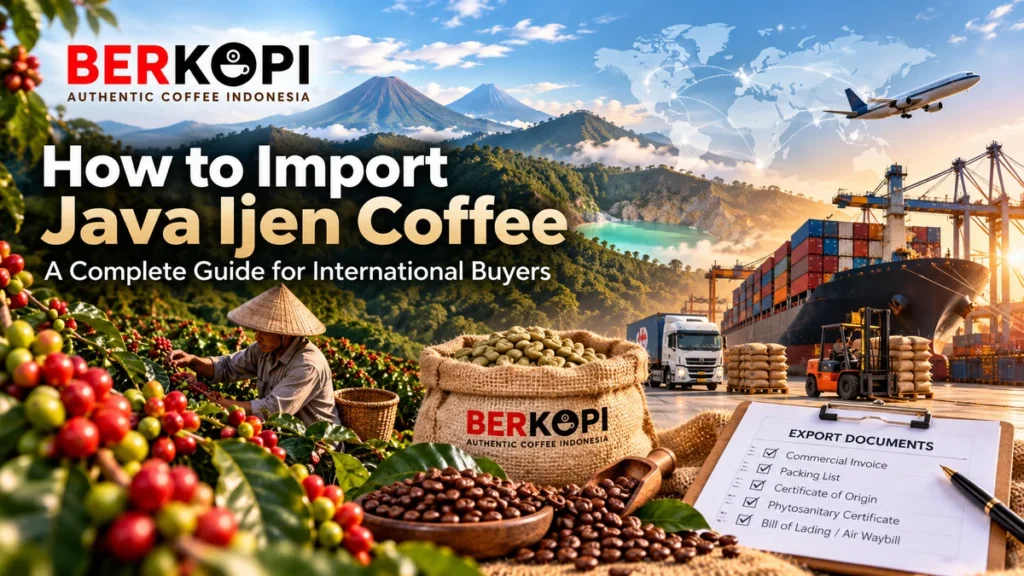
Introduction: Discover the Character of Java Ijen Coffee
Indonesia is recognized as an important coffee-producing country, offering a wide variety of coffee origins, processing methods, and flavor profiles. Among these origins, Java Ijen Coffee offers an opportunity for international buyers seeking Indonesian coffee with a distinctive regional identity.
Grown in the highland areas around the Ijen region of East Java, coffee from this area can appeal to specialty coffee roasters, importers, distributors, and businesses looking to expand their coffee portfolios.
Whether you are sourcing green coffee beans for roasting, roasted beans for retail, or coffee for your own brand, understanding the import process is an essential first step.
In this guide, Berkopi Nusantara explains how international buyers can source and import Java Ijen Coffee from Indonesia, from selecting the right product to preparing documentation and arranging international shipping.
1. Understand the Different Types of Java Ijen Coffee
Before importing coffee, determine which product best fits your business model, target market, and production requirements.
Arabica Java Ijen
Arabica coffee is often selected by specialty coffee roasters and premium coffee brands. Depending on the lot, variety, growing conditions, and processing method, Arabica Java Ijen may offer a range of flavor characteristics.
Available processing styles may include:
Full Wash: Often associated with a clean cup profile and clearly defined acidity.
Natural Process: Coffee cherries are dried with the fruit surrounding the beans, potentially contributing fruit-forward characteristics.
Honey Process: A processing method that retains some mucilage during drying and can produce a range of sweetness and texture.
These descriptions are general tendencies, not guarantees. Buyers should request a current sample and evaluate each lot through cupping before making a purchasing decision.
Robusta Java Ijen
Robusta coffee may be suitable for espresso blends, traditional coffee products, instant coffee applications, and businesses seeking a different balance of body, bitterness, and flavor.
The best choice depends on the intended application, target customers, and required quality specifications.
Choose Your Product Format
International buyers can generally consider two main product categories:
Green Coffee Beans
Green beans are suitable for importers and roasters who want to control roasting profiles, develop their own blends, and manage production locally.
Roasted Coffee Beans
Roasted beans may suit distributors, cafés, and retailers that prefer a ready-to-use product. Buyers should evaluate packaging, shelf life, freshness, labeling, and the destination country’s food regulations.

2. Find a Reliable Java Ijen Coffee Supplier
Choosing the right supplier is one of the most important steps in importing coffee.
A supplier should be able to explain the coffee’s origin, processing method, available quantity, quality specifications, and commercial terms.
When evaluating a potential supplier, consider the following:
Origin traceability: Ask where the coffee was grown and processed.
Product consistency: Request information about lot identification and quality control.
Stock availability: Confirm whether the coffee is physically available or must be sourced after an order.
Samples: Request representative samples before confirming a commercial purchase.
Communication: Make sure the supplier can provide clear quotations, documentation, and shipment updates.
Export readiness: Confirm whether the supplier can export directly or works with an export partner.
For specialty coffee, transparency is particularly important. Buyers should understand what is being offered rather than relying on a product name or origin description alone.
Berkopi Nusantara focuses on Indonesian coffee, including Arabica and Robusta from the Ijen region of East Java. International buyers can contact the team to discuss product availability, processing options, samples, and potential supply arrangements.
3. Request Samples and Verify Coffee Quality
Never rely solely on photographs, descriptions, or a supplier’s general quality claims when evaluating a new coffee lot. Before placing a substantial order, request a sample that represents the coffee being offered.
For green coffee beans, consider evaluating:
Moisture content and water activity, where relevant.
Physical appearance, bean size, and defect levels.
Aroma and cup quality.
Processing consistency.
Packaging condition and storage history.
Lot identification and traceability.
For roasted coffee, evaluate roast consistency, aroma, flavor, packaging integrity, and freshness.
It is also helpful to agree on the quality specifications in writing. Depending on the buyer’s needs, these may include variety, process, grade, screen size, moisture limits, defect tolerances, and a documented cupping profile.
The specifications should be appropriate for the particular product and destination market.
4. Confirm Minimum Order Quantity, Pricing, and Payment Terms
Once the product has been evaluated, the next step is to request a formal quotation.
The price of Java Ijen Coffee may vary according to the coffee variety, processing method, grade, harvest, available quantity, packaging, and order volume.
A complete quotation should clearly state:
Product name and origin.
Green bean or roasted bean format.
Processing method and agreed specifications.
Available quantity and minimum order quantity.
Price per kilogram or metric ton.
Packaging type and weight.
Price basis, such as EXW, FOB, or CIF, where applicable.
Payment terms and quotation validity.
Estimated preparation and shipping schedule.
Buyers should compare quotations on the same commercial basis. For example, an FOB quotation and a CIF quotation do not include the same costs.
The final landed cost may include the coffee price, international freight, insurance, customs duties, import taxes, customs clearance, local transport, and other destination-specific charges.
Ask the supplier and your freight forwarder to clarify which costs are included before confirming the order.
5. Prepare the Required Export and Import Documents
International coffee shipments require proper documentation. The exact requirements depend on the product, shipment method, and destination country.
For coffee exported from Indonesia, the exporter may need to coordinate documents and procedures relating to customs, origin certification, and applicable quarantine or other regulatory requirements.
Common documents to discuss with the exporter and logistics provider include:
Commercial Invoice|
Records the seller, buyer, product description, quantity, value, and agreed commercial terms.
Packing List
Describes the number of packages, packaging details, net weight, gross weight, and other shipment information.
Bill of Lading or Air Waybill|
Provides the transport document for sea freight or air freight, respectively.
Certificate of Origin
A document used to establish the origin of the exported goods. The appropriate certificate and its eligibility should be confirmed for the shipment and destination.
Phytosanitary Certificate, When Required
Certain destinations impose plant-health requirements on green coffee beans. Buyers and exporters should verify the applicable rules with the relevant authorities before shipment.
Other Required Certificates and Declarations
Additional documentation may be necessary depending on the product, destination, food-safety requirements, and importer’s obligations.
Indonesian coffee export procedures and supporting documents should be verified through the relevant Indonesian authorities and current trade guidance. The Indonesian Coffee Exporters Association also provides an overview of export requirements: https://gaeki.or.id/en/ketentuan-ekspor-kopi/
6. Check the Import Regulations in Your Destination Country
A shipment that is prepared correctly in Indonesia must still comply with the rules of the destination country.
Before confirming an order, buyers should verify:
Importer registration or licensing requirements, where applicable.
Food safety and facility registration requirements.
Customs classification and applicable duties or taxes.
Plant-health and quarantine conditions.
Product labeling and packaging rules.
Any additional certificates or testing requirements.
For example, commercial food imports into the United States are subject to applicable FDA requirements, which can include food facility registration and prior notice of imported food. Importers may also have obligations under the Foreign Supplier Verification Programs, depending on the circumstances.
Official guidance is available from the U.S. Food and Drug Administration: https://www.fda.gov/importing-food-products-united-states
Buyers importing into the European Union should also check applicable food-import requirements and relevant environmental rules. Coffee is covered by the EU Deforestation Regulation, so businesses should verify the current implementation dates and obligations that apply to their transaction.
Important: Requirements can change. Always confirm the current rules with the destination country’s competent authorities, customs broker, or qualified import specialist before the shipment leaves Indonesia.
7. Choose the Right Shipping Method
The most suitable shipping method depends on order volume, delivery urgency, product format, and total logistics cost.
Sea Freight
Sea freight is commonly considered for larger commercial orders because it can offer economical transport on a per-unit basis.
Depending on shipment size and logistics arrangements, buyers may compare:
LCL (Less than Container Load): For cargo that shares container space with other shipments.
FCL (Full Container Load): For cargo shipped in a dedicated container.
Air Freight
Air freight may be appropriate for samples, small urgent orders, or shipments where speed is more important than transport cost.
For either method, confirm the shipping route, estimated transit time, freight charges, cargo insurance, destination handling fees, and customs clearance arrangements.
Coffee should be packed and handled to protect it from moisture, contamination, and other conditions that could affect quality during transit.
8. Understand Incoterms and Your Responsibilities
Incoterms help buyers and sellers define responsibilities for delivery, costs, and the transfer of risk.
Three commonly discussed options are:
EXW (Ex Works): The seller makes the goods available at the agreed location, with substantial transport and export responsibilities generally falling to the buyer.
FOB (Free On Board): For sea or inland waterway transport, the seller’s responsibilities generally extend to placing the goods on board the vessel at the named port of shipment.
CIF (Cost, Insurance and Freight): For sea or inland waterway transport, the seller pays the cost and freight to the named destination port and arranges the required insurance under the rule.
The named place or port and the applicable Incoterms edition should be stated in the sales agreement.
Do not compare prices without checking which costs and responsibilities are included. A lower initial quotation may not produce a lower total landed cost.
9. Inspect the Shipment and Build a Long-Term Supply Relationship
Once the shipment arrives, the importer should check the delivered goods against the agreed specifications and shipping documents.
Depending on the contract, this may involve verifying package counts, weights, lot numbers, packaging condition, and product quality.
Any discrepancies should be documented promptly and handled according to the agreed claims procedure.
For repeat purchases, keep records of the supplier, lot, quality results, delivery performance, and customer feedback. This information can help buyers make more consistent purchasing decisions over time.
Building a long-term relationship with a transparent supplier can also make it easier to plan future orders, discuss seasonal availability, and maintain consistent product specifications.
10. Start Importing Java Ijen Coffee with Berkopi Nusantara
Finding the right Indonesian coffee supplier is about more than purchasing beans. It is about finding a product that meets your quality expectations, commercial requirements, and customer needs.
Berkopi Nusantara welcomes inquiries from international coffee importers, specialty roasters, distributors, cafés, and businesses interested in Indonesian coffee.
Depending on current availability, buyers can discuss:
Arabica Java Ijen and Robusta Java Ijen.
Different coffee processing methods.
Green coffee beans and roasted coffee beans.
Product samples and quality specifications.
Available quantities and minimum order requirements.
Export quotations and shipping arrangements.
If you are developing a specialty coffee portfolio, sourcing Indonesian coffee for your roasting business, or exploring a new origin for your market, our team can help you discuss the options.
Contact Berkopi Nusantara to request product information, check current availability, and discuss a quotation for Java Ijen Coffee.
Visit our website: https://berkopi.com/
Frequently Asked Questions
Java Ijen Coffee refers to coffee sourced from the Ijen region of East Java, Indonesia. Available products may include Arabica and Robusta, with characteristics that vary according to origin, variety, processing, and lot.
Green coffee beans are a common option for international importers and roasters. The shipment must meet the applicable Indonesian export procedures and destination-country import requirements.
The minimum order quantity depends on the supplier, product, available stock, packaging, and shipment arrangement. Contact Berkopi Nusantara to confirm current availability and order requirements.
Yes. Sample availability and shipping arrangements should be confirmed with the supplier. Buyers should evaluate representative samples before agreeing to a larger commercial order.
Requirements vary by destination and product type. Common documents may include a commercial invoice, packing list, transport document, and applicable origin or phytosanitary documentation. Additional requirements may apply.
The total cost depends on the product price, quantity, packaging, shipping, insurance, customs duties, taxes, clearance, and local delivery. Request a quotation with clearly stated trade terms to estimate the total landed cost.
Availability depends on the product, harvest, stock, and order requirements. Contact Berkopi Nusantara to discuss the current supply options and export arrangements.
Final Thoughts
Importing Java Ijen Coffee can open opportunities for businesses looking to source coffee from Indonesia. The key is to combine careful supplier selection, sample evaluation, clear commercial terms, accurate documentation, and compliance with destination-country regulations.
With proper preparation, international buyers can make more informed sourcing decisions and develop a reliable supply relationship for their coffee business.
Explore Indonesian coffee with Berkopi Nusantara and start a conversation about sourcing Java Ijen Coffee for your market.